

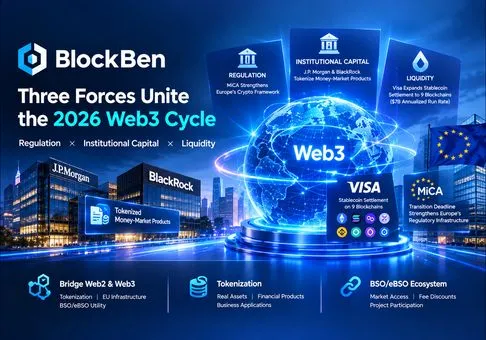
Retail can light the match. But regulation, institutional capital and liquidity are building the engine.
Crypto has always moved in cycles. Retail attention returns, liquidity follows, narratives get louder, everyone suddenly remembers their exchange password and, sooner or later, someone declares that “this time is different.”
Usually, it isn't.
But 2026 is giving us a reason to pay attention. Not because retail has stopped mattering — it hasn't. Retail demand remains one of the strongest accelerators in crypto. What's changing is the infrastructure underneath it.
We see three forces beginning to reinforce each other: regulation, institutional capital and liquidity. Call it the Web3 Convergence Loop.
And you don't need to go back several years to find evidence. A lot of it happened in 2026.
The institutions are already moving
In May 2026, J.P. Morgan Asset Management launched JLTXX, its second tokenized money-market fund, directly on public Ethereum. J.P. Morgan Asset Management itself put $100 million into the fund at launch.
Then in August, BlackRock launched its first tokenized access to funds in Europe. Using Kinexys by J.P. Morgan, selected institutional money-market fund share classes can now be represented by digital tokens minted on Ethereum. The underlying platform covers approximately $311 billion in combined assets under management.
And it isn't only asset managers.
In April, Visa expanded its stablecoin settlement pilot to nine blockchains, reporting a $7 billion annualized stablecoin settlement run rate, up 50% from the previous quarter. Visa also started operating its own validator node on the Tempo blockchain earlier that month.
That's quite a lot of “traditional finance” happening on-chain in a few months.
The question is gradually moving from “Will institutions enter crypto?” to “Which parts of financial infrastructure will move on-chain next?”
And that's a much more interesting question for the next Web3 cycle.
Europe is changing at the same time
There is another 2026 milestone that matters.
On 1 July 2026, the maximum EU transitional period for crypto-asset service providers under MiCA expired. For the European crypto industry, that marks an important shift from transition toward operating under the EU-wide framework.
KYC, AML, custody, reporting, risk management and operational controls aren't exactly the ingredients of a viral meme. They are, however, part of the infrastructure serious businesses need if Web3 is going to move beyond experimentation.
For years, parts of crypto grew through regulatory arbitrage: find somewhere to launch, move fast and deal with the difficult questions later. Europe is increasingly moving in the opposite direction — from regulatory arbitrage toward regulatory infrastructure.
And that's where things start connecting.
Institutional products are moving on-chain. Payment infrastructure is connecting to stablecoins and blockchain networks. Europe is operating under MiCA. At the same time, businesses need better ways to connect all of this to actual products and users.
That's the Web3 Convergence Loop: regulation, institutional capital and liquidity reinforcing each other.
Retail can then accelerate something that already has much more infrastructure underneath it.
The token was never the difficult part
This shift has also changed how we think about BlockBen.
Web3 spent years treating the token launch as the big event. Build tokenomics, run the presale, get the listing, celebrate and move on to the next project.
But issuing a token is increasingly the easy part.
The difficult part is creating an ecosystem around it that people actually want to use. A project still needs a real business, management, users, distribution, communication, onboarding, wallets, transactions, market access and a reason for the token to exist in the first place.
One principle we've become increasingly convinced about is simple: tokenomics cannot compensate for the absence of distribution.
A brilliant token model with no users is still a brilliant token model with no users.
That's why BlockBen's direction is broader than being a launchpad. We're building toward EU crypto commercialization infrastructure: helping traditional businesses move from Web2 into Web3 through tokenization, while helping existing Web3 businesses enter and operate in Europe through Powered by BlockBen.
For a traditional company, that can mean taking an existing business, product and customer base and adding a meaningful token layer. For a Web3 company, the proposition is different: keep your brand, product and community while plugging into the European infrastructure needed underneath it.
From launching tokens to building ecosystems
BSO/eBSO sits inside that bigger picture too. eBSO is designed for external interoperability, transfer and trading, while BSO is the ecosystem participation side of the same crypto. Through the Ecosystem Participation Program, BSO can connect users with tiers and available ecosystem benefits as the network develops.
The exchange can therefore be an entry point rather than the destination.
So what does the next cycle look like?
Nobody knows. And anyone giving you the exact date and size of the next bull market probably also has a Telegram group they'd like you to join.
What we can see is what has happened in 2026 alone.
J.P. Morgan Asset Management launched another tokenized fund on Ethereum. BlackRock brought tokenized access to institutional funds in Europe. Visa expanded stablecoin settlement across nine blockchain networks. And the EU's maximum MiCA transition period came to an end.
None of that guarantees where crypto prices go next.
But it tells us something important about where the infrastructure is going.
Retail demand could accelerate all of this dramatically when market attention returns. But this time, retail may not be arriving at an empty construction site.
There is already an engine being built underneath it.
Regulation, institutional capital and liquidity are beginning to converge — and BlockBen is building for the businesses and ecosystems that want to operate where those three meet.